Type 38 Arisaka Serial Numbers
Microsoft excel windows 7 download. Many Chinese troops, both Nationalist and Communist, used captured Arisaka Type 38 rifles against the Japanese during the Second Sino-Japanese War. Manufacturing of Arisaka Type 38 rifles did not cease until the end of WW2, but existing models remained in service.
| Arisaka rifles | |
|---|---|
| Type | |
| Place of origin | Japan |
| Service history | |
| In service | 1897–1961 |
| Production history | |
| Designer | Arisaka Nariakira Nambu Kijirō |
| Designed | 1897 |
| Variants | Type 30 Type 30 carbine Type 35 Type 38 Type 38 carbine Type 38 sniper rifle Type 44 carbine Type 97 sniper rifle Type 99 Type 99 sniper rifle TERA |
| Specifications | |
| Cartridge | 6.5×50mmSR Type 30 6.5×50mmSR Type 38 7.7×58mm Type 92 7.7×58mm Type 97 7.7×58mm Type 99 |
| Action | Bolt-action |
| Feed system | 5-round internal magazine (reloaded via stripper clip) |
| Sights | Rear: ladder, tangent (Type 35) Front: fixed blade Sniper variants: factory-zeroed scope |
The end result is a Type 38 which is similar in size to the Arisaka Type 99 short rifle. There is no consistency to serial numbers or arsenal marks as the rifles were converted from existing stock. Although total production is unknown, it is estimated that approximately 100,000 were converted. Chinese Six/Five infantry rifle. Nov 06, 2004 Vaughn, Please recheck the s/n or series of your rifle. The serial number range for the Nagoya '0' series Type 38 begins in the 2 million range. The observed serial number range is 2021802 to 2031433 with a production run of only about 6000 rifles. Arisaka Type 38 Rifle Interactive Map. I have a Arisaka Type 38 Serial Number 333972. The stock does not look like any I have seen before and the barrel length is shorter than the specifications for this type. The World War II Database is founded and managed by C. Peter Chen of Lava Development, LLC. The goal of this site. In the late 1930's the Japanese developed a rifle to compete in 'Modern Warfare'. It was a redesign of the Type 38 in a larger caliber, 7.7 Japanese. These rifles include: The Type 99 Long Rifle, the Type 99 Short Rifle, the Type 99 Carbine, the Type 99 Naval Special, the Type 100 Paratroop Rifle, and the Type 2 Paratroop Rifle.
The Arisaka rifle (有坂銃 Arisaka-jū) is a family of Japanese militarybolt-actionservice rifles, in production and use since approximately 1897, when it replaced the Murata rifle (村田銃 Murata-jū) family, until the end of World War II in 1945. The most common specimens include the Type 38 chambered for the 6.5×50mmSR Type 38 cartridge, and the Type 99 chambered for the 7.7×58mm Type 99 cartridge, which is comparable in power to a modern .308 Winchester round. Many thousands of Type 99s and other Arisaka variants were brought to the United States by soldiers as war trophies during and after World War II.
- 2Models
- 2.1Type 30
- 2.2Type 38
- 2.5Type 99
- 3Bayonets
History[edit]
The Arisaka rifle was designed by Colonel Arisaka Nariakira (有坂 成章; 1852–1915), who was later promoted to lieutenant general and also received the title of baron from Emperor Meiji, in 1907. Over the course of various wars several productions runs and variants were made, including the transition from the 6.5mm Type 38 cartridge to the larger 7.7mm Type 99, and the introduction of a paratrooper rifle that could be disassembled into two major parts for airborne operations. Tests on samples of Arisaka rifles conducted after the war showed that their bolts and receivers were constructed of carbon steel 'similar to SAE steel grade No. 1085 with a carbon content of 0.80% to 0.90%, and a manganese content of 0.60% to 0.90%.'[1] During destructive tests, the Arisakas were shown to be stronger than the M1903 Springfield, Lee–Enfield, and Mauser rifles.[2] The Arisaka's were also one of the only guns of the era to use polygonal rifling in its barrels, rather than the more traditional lands and grooves.
Some of the early issue Type 99 rifles were fitted with a folding wire monopod intended to improve accuracy in the prone position. The rear sights also featured folding horizontal extensions to give a degree of lead suitable for firing against aircraft. Near the end of World War II, last-ditch ersatz models were being made in various cost-cutting feature variations with the goal of cheaply bolstering the imperial armed forces; for example, the ovoid bulb-shaped bolt of earlier runs were replaced by a smaller and utilitarian cylindrical shape, the handguard on the barrel was omitted, and crude fixed sights were fitted.
The Arisaka bolt-action service rifle was used everywhere in the Imperial Japanese Army and the Imperial Japanese Navy. Prior to World War II, Arisakas were used by the British Navy and Russian Army, in Finland and Albania. The Czech Legions that fought in the Russian Revolution were almost entirely armed with Type 30s and 38s. Many captured Arisaka rifles were employed by neighboring countries both during and after World War II, in places such as China, Thailand and Cambodia. However, after the Japanese surrender in the summer of 1945, manufacture of rifles and ammunition stopped abruptly, and the Arisaka quickly became obsolete. Since most Imperial Japanese Armory contents were thrown into Tokyo Harbor after the signing of the surrender, spare ammunition also became rare. Additional 6.5×50mmSR ammunition was, however, produced in China for use in their captured rifles.
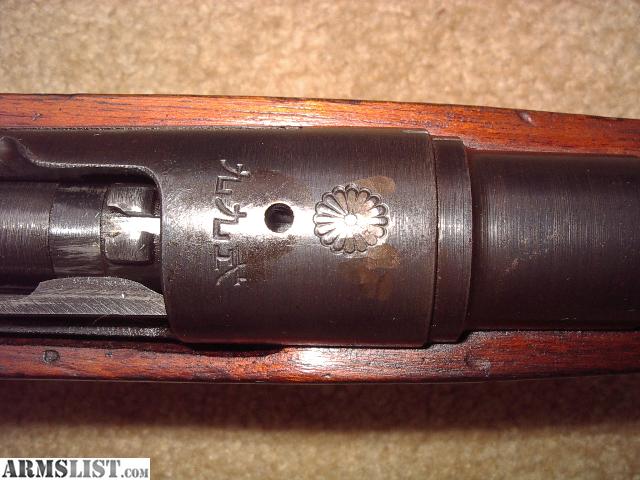
The imperial ownership seal, a 16-petal chrysanthemum known as the Chrysanthemum Flower Seal stamped upon the top of the receiver in all official imperial-issue rifles, has often been defaced by filing, grinding, or stamping on surviving examples. There are conflicting claims that this was done on the orders of the Imperial Japanese Military prior to surrender, however it is generally accepted by most historians that the imperial chrysanthemums were ground off the rifles on the orders from General Douglas MacArthur, the commander of occupation forces at that time.[3] To date, no documentation from either Japanese or U.S. forces has been found that required the defacing. Most of the Arisakas with surviving insignia are in Japan, though there are a few remaining on samples taken as war trophies before the surrender, and those captured by Chinese forces. Some of the captured Sino Arisakas were later exported to the United States, examples including a number of Type 38 carbines rebarrelled and rechambered for the 7.62×39mm round. Some Type 38 rifles captured by the Kuomintang forces were also converted to fire the 7.92×57mm Mauser round.
Many of the Chrysanthemum Seals were completely ground off, but some were merely defaced with a chisel, scratch or had the number '0' stamped repeatedly along the edges. The latter was usually done with rifles removed from Japanese military service (and thus no longer the emperor's property), including rifles given to schools or sold to other nations, such as the British Royal Navy's purchase of many Type 38s in World War I to free up SMLE rifles for their land forces.
A very small run of Type 38 rifles was also manufactured for export to Mexico in 1910, with the Mexican coat of arms instead of the imperial chrysanthemum, though few arrived before the Mexican Revolution and the bulk remained in Japan until World War I, when they were sold to Imperial Russia.
Models[edit]
Type 30[edit]
First rifle of the Arisaka series. Chambered in 6.5×50mmSR Type 30. 554,000 built.
Type 30 carbine[edit]
Carbine variant of the Type 30; 300 mm shorter. 45,000 built.
Type 35[edit]
Officially designated as Type 35 navy rifle. Also in 6.5×50mmSR Type 30.
Design improvement based on the Type 30 for the Imperial Japanese Navy Land Forces by Major Nambu Kijirō. Changes include tangent type rear sight, separate sliding bolt cover (as opposed to simultaneously moving ones on all other types after) of the same type later used on the Siamese Mauser style rifle, hook safety replaced with a large knob cocking piece to protect from gases in case of a blown primer, larger bolt handle knob, improved bolt head, gas port in bolt body, and improved chamber configuration for better cartridge feeding.
Type 38 Arisaka Serial Numbers
Type 38[edit]
Developed by Major Nambu Kijirō. Chambered in 6.5×50mmSR Type 38, Type 30 cartridge is also usable. A short variant exists for ease of handling, its length is between the basic rifle and the carbine.
One of the most produced and commonly encountered model. Designed in 1905 and simultaneously produced until 1942 with 3,400,000 built.
Type 38 carbine[edit]
Carbine variant of the Type 38; 300 mm shorter. Also fielded by support personnel.
Type 44 carbine[edit]
Carbine derived from the Type 38 rifle. Chambered in 6.5×50mmSR Type 38, Type 30 cartridge is also usable. Distinguishing features are its folding spike bayonet and two-piece takedown cleaning rods concealed within the buttstock. Originally intended for the cavalry, also used by other support personnel.
Type 97 sniper rifle[edit]
One of the two main sniper rifles in imperial military service. Based on the Type 38 rifle. Chambered in 6.5×50mmSR Type 38, but more commonly used reduced charge cartridges associated with the Type 11 and 96 light machine guns for lighter recoil, reduced report, camouflaged muzzle flash, and overall accuracy. Uses factory-zeroed Type 97 telescopic sight (2.5X).
About 22,500 built.
Type 99[edit]
Successor to the Type 38 rifle. Chambered in 7.7×58mm Type 99, later rimless variants of the Type 92 and 97 cartridges also usable.
Designed in 1939, then produced and fielded from 1941 to 1945, the Type 99 was the most common Imperial Japanese service rifle of World War II and second most produced imperial rifle with 2,500,000 built. Significant changes are the improvement of the rear sight form transitioning from a V-notch type like those on a Type 38, to an aperture, the front sight blade was renewed to a triangular shape, chrome-lined barrels were used, and on earlier productions, the rear sight was equipped with anti-aircraft calipers.
Sub-variations included a long rifle (approximately only 38,000 made), and short rifle; former being 1258 mm in total and latter being 1118 mm. The short rifle also varied in quality from initial, intermediate, to last-ditch.
Arisaka Type 38 Identify
Type 99 sniper rifle[edit]
The other sniper rifle of the Imperial Japanese Military. Built on both the long and short models with the latter being higher in number. Chambered in 7.7×58mm Type 99, later rimless variants of the Type 92 and 97 cartridges also usable. The larger, more powerful caliber allowed the ballistics to be less affected by windage at the cost of stronger recoil. Two different types of scopes were issued to the rifles: the Type 97 2.5X telescopic scope, or the Type 99 4X telescopic scope. Later productions of the Type 99 scope allowed for distance adjustment. Each scopes were issued with their respective holsters, and were often detached from the rifle and placed within them while advancing.
By doctrine, snipers of the imperial military were selected by his skill in marksmanship and the caliber of the rifle he was assigned to corresponded with the ammunition of the company he was under.
Production began in May 1942. Total number made is approximately 10,000.
TERA[edit]
A small series of takedown rifles produced for the imperial army paratroopers and imperial navy paratroopers. Only production model is the Type 2 based on the Type 99 short rifle; the rest are two proto-test types (Type 100 and Type 1). The Type 2 is chambered in 7.7×58mm Type 99, later rimless variants of the Type 92 and 97 cartridges also usable.
The Type 2 allowed for compact storage by breaking down to two pieces: the stock and action, and barrel and handguard.
About a total of 19,000 were produced from 1942 to 1944.
Bayonets[edit]
Type 30[edit]
Created simultaneously with the Type 30 rifle, this sword-type bayonet is compatible with all variants of the Arisaka rifle except for the Type 44 carbine. Twenty different variations exist, and is further categorized by early, mid, and late-war production phases. Also fixable on Type 96 and 99 light machine guns.
Type 35 bayonet[edit]
The Type 35 bayonet was a slightly modified Type 30 bayonet made specifically for the Type 35 rifle. The dimensions of the bayonet is almost exactly the same as the Type 30 bayonet. The only real difference between the two is the added addition of a sprung catch that hooks into the scabbard when not in use.[4]
Windows system32 driverstore huge. About 8,400,000 were made.
Type 44[edit]
Fixed permanently on the Type 44 carbine, this spike-type bayonet is foldable under the handguard and does not interfere with the barrel when deployed.
Type 2[edit]
With the long length of the Type 30 bayonet unfit for concealing within a paratrooper's personal equipment set, this knife-type bayonet was created to address this issue. Twenty centimetres shorter than a Type 30, its total length is 32.3 cm. Used primarily with the Type 2 TERA rifle or the Type 100 submachine gun by the Imperial Military Airborne Divisions.
About 25,000 were made.
Users[edit]
- Austria-Hungary: Some captured at the Eastern front during World War I. When available ammunition was running out some were converted to the 6.5×54mm Mannlicher–Schönauer cartridge and their rear sight leafs were possibly replaced with Mannlicher M95 type ones.[5]
- Empire of Japan: used by Japanese Imperial Military.
- China: captured or confiscated from Japanese Imperial Military.
- Cambodia: captured or confiscated from Japanese Imperial Military.[citation needed]
- Khmer Issarak: Used during First Indochina War.
- Khmer Rouge: Used during Vietnam War.
- Czechoslovakia: Used by Czechoslovak Legion During Russian Civil War.[6]
- Estonia: Independence War, Defense League Kaitseliit (Home Guard); many were converted to fire .303 British cartridges.
- Finland: Some used by the Finnish Army.[7]
- Finnish People's Delegation: used various models in Finnish Civil War.[citation needed]
- France: Arisaka rifles were exchanged to units assigned to man front-line trenches during World War One. This was to conserve scarce stocks of Lebel and Berthier rifles for exploitation and follow-on formations that would otherwise be damaged or destroyed in a bombardment.
- Indonesia: captured or confiscated from Japanese Imperial Military.[citation needed]
- Kingdom of Hejaz: Supplied by Royal Navy to Lawrence of Arabia for Arab Forces during Arab Revolt.[8]
- Laos: captured or confiscated from Japanese Imperial Military.[citation needed]
- Malaya: captured or confiscated from Japanese Imperial Military.[citation needed]
- North Korea: captured or confiscated from Japanese Imperial Military.[citation needed]
- Philippines: captured or confiscated from Japanese Imperial Military.[citation needed]
- Second Polish Republic: captured or confiscated ex-Russian stocks of Arisaka Type 30 (c.1897AD), Type 35 (c.1902AD) and Type 38 (c.1905AD) rifles and carbines[9]. The Arisaka Type 30 rifle was classified as the karabin japoński wz.97 Arisaka, the Type 30 Carbine was the karabinek japoński wz.97 Arisaka, the Type 38 rifle was classified as the karabin japoński wz.05 Arisaka and the Arisaka Type 38 Carbine was the karabinek japoński wz.05 Arisaka. They were issued to police, border guards and paramilitary militia formations.
- Republic of China: Some were captured or confiscated from Japanese Imperial Military.
- Fengtian Clique: Used by Chang Tso-lin's army during Warlord Era.[10]
- Russian Empire: purchased Type 38 rifles during World War I.[11]
- Soviet Russia: several Red Army units used rifles during Russian Civil War.[12][13]
- Thailand: built under contract with 8 mm. Siamese Mauser ammunition (8x52 mm. R Type 66) and locally called 'Type 66 Rifle'.[14]
- United Kingdom: a mixed batch of Type 30 and Type 38 rifles were received by Britain at the start of World War I for use in training battalions, declared obsolete in 1921. The Royal Navy also used Arisakas to free up the Lee–Enfields for land forces.[citation needed]
- Vietnam: captured or confiscated from Japanese Imperial Military.[15]
Details[edit]
As with all captured foreign firearms they may be dangerous when fired, due to both the lower quality of the 'last-ditch' rifles produced during the end-half of World War II, and to modifications performed by returning U.S. servicemen on those rifles. Ammunition for the Arisaka series, which were often battlefield pick-ups, or souvenirs, were not readily available after the end of the war. Consequently, many were rebored or rechambered for readily available calibers of that time. Additionally, some were occasionally rendered inoperable prior to being shipped home, or even potentially sabotaged. The manner in which rifles may have been demilled can include permanently damaging the receiver or removal of parts.
Type 38s in particular were commonly rechambered to 6.5×.257 Roberts, a wildcat cartridge made using the readily available .257 Roberts cases with the neck expanded to use 6.5mm bullets specific to the already existing barrel. Likewise, the Type 99 in 7.7×58mm were known to be converted to .30-06 Springfield, which is again of similar but not identical dimensions. While the .30-06 can be fired by lengthening the chamber of the rifle slightly (from 58 to 63mm), the 7.7mm case is slightly wider than the .30-06 and uses a slightly larger-diameter bullet, meaning a .30–06 cartridge case will swell slightly to fit the oversized chamber, and a standard .30-06 bullet with a .308 diameter will not provide a good fit to the .310–312 diameter rifling.
Those seeking ammunition for their Type 99 rifles often manufacture it by modifying .30–06 cases. The German 7.92×57mm Mauser cartridge may also be used with the proper .311 diameter bullet. The widely available British .303 bullets also provide a proper fit for the firearm's rifling. Norma currently manufactures stock 7.7×58mm ammunition, as well as making new brass available for reloaders. Hornady also produces new Arisaka ammunition in both 6.5mm and 7.7mm calibers. Since the base of the 7.7mm case is slightly larger than the .30-06 (thereby causing varying amounts of bulging in the reformed brass), some owners may find it preferable to use proper brass or new factory cartridges. Bullets and powder charges of surplus .303 British ammunition may also be loaded into proper 7.7×58mm cases to produce rifle cartridges with ballistics that are similar to the original Japanese military load.
| Preceded by Murata | Imperial Japanese Army service rifle 1898–1945 | Succeeded by End of the Imperial Japanese Military M1 Garand |
Gallery[edit]
Full view of a late model Type 99
Buttstock of the Type 99
Locked Type 99 bolt
Unlocked Type 99 bolt
Close-up of the Type 99 bolt
Barrel of the Type 99 showing rifling
Type 30 bayonet
Type 99 with Type 30 bayonet attached
See also[edit]
References[edit]
- Honeycutt, Fred L. Jr and Anthony, Patt F. Military Rifles of Japan. Fifth edition, 2006. Julin Books, U.S.A. ISBN0-9623208-7-0.
- ^Hatcher p. 231
- ^Hatcher p. 206
- ^Honeycutt & Anthony p. 12
- ^Allan; White; Zielinkski. p. 78
- ^http://www.hungariae.com/Arisaka.htm
- ^Allan; White; Zielinski. p. 90-95
- ^http://www.jaegerplatoon.net/RIFLES5.htm
- ^Allan; White; Zielinski. p. 90-95
- ^IAA Forum General Discussion 6,5x50SR Arisaka in Polish Army
- ^Historical Dictionary of Modern China (1800-1949) by James Z. Gao; Scarecrow Press, 16 jun. 2009; p.115
- ^'Во время первой мировой войны царская Россия испытывала недостаток в стрелковом вооружении, поэтому в армии кроме винтовок русского образца были также и иностранные – японские Арисака обр.1897 и 1905 гг., австро-венгерские Манлихера 1889 и 1895 гг., германские '88' и '98'. Кроме этих винтовок использовались также и устаревшие образцы, стрелявшие патронами, снаряженными дымным порохом – Бердана № 2 образца 1870 г., Гра 1874 г., Гра-Кропачека 1874/85 г., Веттерли 1870/87 г.'
А. Б. Жук. Энциклопедия стрелкового оружия: револьверы, пистолеты, винтовки, пистолеты-пулеметы, автоматы. М., АСТ — Воениздат, 2002. стр.587 - ^С. Кляцкин. Строительство Красной Армии в 1918 году // журнал 'Вопросы истории', № 2, февраль 1948. стр.49–69
- ^Винтовка // Гражданская война и военная интервенция в СССР. Энциклопедия / редколл., гл. ред. С. С. Хромов. — 2-е изд. — М., «Советская энциклопедия», 1987. стр.94–95
- ^https://www.forgottenweapons.com/saimese-mauser-followup-the-type-66-rifle/
- ^Windrow, Martin (20 Sep 2018). French Foreign Légionnaire vs Viet Minh Insurgent: North Vietnam 1948–52. Combat 36. Osprey Publishing. pp. 24–25. ISBN9781472828910.
- Hatcher, Julian, Major General, (U.S.A. Ret). Hatcher's Notebook. Stackpole Publishing, Harrisburg, PA U.S.A.; 1962. Library of Congress Number 62-12654.
External links[edit]
- 小銃 日本の武器兵器 Rifles Japanese Weapons[dead link]
| Type 38 Rifle | |
|---|---|
Type 38 rifle from the collections of the Swedish Army Museum | |
| Type | Service/bolt-action rifle |
| Place of origin | Japan |
| Service history | |
| In service | 1906–1945 (Japan) |
| Used by | See Users |
| Wars | Russian Civil War World War I Second Sino-Japanese War World War II Chinese Civil War Indonesian National Revolution Malayan Emergency Korean War First Indochina War Vietnam War[citation needed] |
| Production history | |
| Designed | 1905 |
| No. built | 3,400,000 |
| Variants | Carbine & Cavalry Carbine |
| Specifications | |
| Mass | 4.19 kg (9 lb 4 oz)[1] |
| Length | 1,275 millimetres (50.2 in)[1] |
| Barrel length | 800 millimetres (31 in) |
| Cartridge | 6.5×50mm Arisaka |
| Caliber | 6.5 mm |
| Action | Bolt action |
| Rate of fire | 10-15 rounds per minute[1] |
| Muzzle velocity | 762 m/s (2,500 ft/s) Type 38 cartridge[1] |
| Effective firing range | 366–457 m (400–500 yd) [1] |
| Maximum firing range | 2.37 km (1.47 mi)[1] |
| Feed system | 5-round magazine |
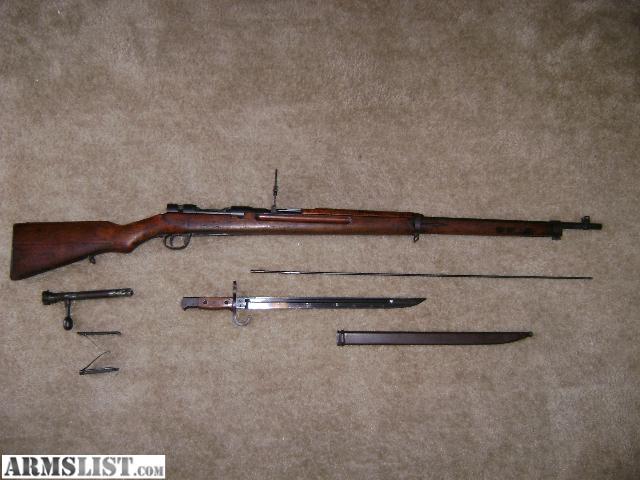
The Type 38 rifle (三八式歩兵銃sanhachi-shiki hoheijū) was a bolt-action rifle that supplemented the Type 99 Japanese standard infantry rifle during the Second World War.[2] The design was adopted by the Imperial Japanese Army in 1905 (the 38th year of the Meiji period, hence 'Type 38') and served from then until the end of 1945.
- 2Description and variant types
History and development[edit]
The Imperial Japanese Army introduced the Type 30 rifle in 1897. However, the weapon had numerous shortcomings, which were highlighted by combat experience in the early stages of the Russo-Japanese War. These included bursting cartridges, a poorly designed lock in which excess gunpowder tended to accumulate, burning the face of the shooter, frequent misfires, jamming, difficulty in cleaning, and cartridge extraction. Major Kijiro Nambu undertook a redesign of the Type 30, which was introduced in 1906. Nambu reduced the number of parts making up the Type 30's bolt from nine to six and at that same time simplified manufacture and disassembly of the bolt without the need for tools.[3] A dust cover was added because of experiences in the Russo-Japanese War that left rifles inoperable from dust.[4] The weapon was produced in several locations:
- Tokyo Arsenal from 1906 to 1932; 2,029,000 units (est.)[5]
- Kokura arsenal from 1933 to 1941: 494,700 units (est.)[5]
- Nagoya arsenal from 1932 to 1942: 312,500 units (est.)[5]
- Jinsen (in what is now Incheon) arsenal from 1942 to 1942: 13,400 units (est.)[5]
- Hoten (was called Mukden Arsenal before the Japanese took it over.[6] In what is now Shenyang) arsenal from 1937 to 1944: 148,800 units (est.)[5]
By 1940 more than three million Type 38s had been issued to the Imperial Japanese Army. However, shortcomings in the Type 38 design during the Second Sino-Japanese War led to the introduction of a further generation of rifles, designated the Type 99 rifle from 1939. This new rifle used the more powerful 7.7×58mm Arisaka cartridge already in use with the Type 92 heavy machine gun and the Type 97 light machine gun. However, not all units received the new weapon, and the mixture of types with incompatible cartridges led to considerable logistics issues during World War II.
Description and variant types[edit]
The Type 38 rifle used the 6.5×50mm Arisaka cartridge. This cartridge produces little recoil when fired. However, while on par with the Norwegian and Italian 6.5mm military cartridges of the time, the 6.5×50mm was not as powerful as several others in use by other nations. The Type 38 at 1,280 mm (50.4 in) was the longest rifle of the war, due to the emphasis on bayonet training for the Japanese soldier of the era, whose average height was 160 centimeters (5 ft 3 in).[7] The rifle was even longer when the 400 mm (15.75 inches) Type 30 bayonet was fixed. The Type 38 was fairly heavy, at about 4.25 kg.
Post-war inspection of the Type 38 by the U.S. military and the National Rifle Association found that the Type 38's receiver was the strongest bolt action of any nation's[8] and capable of handling more powerful cartridges.
Nomenclature note: In the West, Japanese equipment is commonly referred to as 'Type XX', rather than 'Model XX'. In the case of a firearm, 'Model' is a more accurate interpretation of the SHIKI (式) character, but the word 'Type' has become well-established by collectors for decades.
Type 38 carbine[edit]
Intended for use by cavalry, engineers, quartermasters and other non-frontline troops, the Type 38 carbine was introduced into service at the same time as the standard Type 38. Its barrel was 487 millimeters (19.2 in), overall length 966 millimeters (38.0 in), and weight 3.3 kilograms (7.3 lb). The rifle lacked a bayonet. It was produced in a number of locations:
- Tokyo Arsenal from 1906 to 1931; 210,000 units (est.)[9]
- Kokura arsenal from 1938 to 1941: 49,500 units (est.)[9]
- Nagoya arsenal from 1935 to 1942: 206,000 units (est.)[9]
- Hoten/Mukden arsenal from 1938 to 1944: 52,300 units (est.)[9]
Type 44 carbine[edit]
Similar to the Type 38 carbine from the middle band back. The cavalry carbine is almost entirely different from the middle band forward with an under-folding bayonet, metal nosecap, stacking hook to the left side of the nosecap and wide front sight guards. This model was introduced in 1911. There are three variations of this rifle. Each variation based entirely on the nosecap size and the spacing of the nosecap screws. They have a unique storage compartment in the buttstock for a cleaning rod.
Type 97 sniper rifle[edit]
As with the standard Type 38, but with a rifle scope with 2.5x magnification, introduced in 1937. The scope was offset to allow loading by stripper clip and bolt handle slightly bent down. Some 14,000 were produced.
Type 38 short rifle[edit]
In the late 1930s to the early 1940s, an unknown number of Type 38 rifles were converted into short rifles at Nagoya Arsenal, that did all rebuilds of Type 38 and Type 44 rifles and carbines.[10] The barrels were shortened to 635 mm (25.0 in) from the standard 794 mm (31.3 in) barrel and the stock shortened to match the barrel while the handguard retained its original length.[11] The end result is a Type 38 which is similar in size to the Arisaka Type 99 short rifle. There is no consistency to serial numbers or arsenal marks as the rifles were converted from existing stock. Although total production is unknown, it is estimated that approximately 100,000 were converted.[12]
Chinese Six/Five infantry rifle[edit]
Chinese copy of the Japanese Type 38 at the Taiyuan Arsenal in the very late 1920s to early 1930s for the warlord of Shansi province, General Yen Hsi-shan. The receiver is marked 六五步槍 or 'six-five rifle'. Estimated to have been 108,000 made.[13]
Type 918 rifle[edit]
These copies of the Type 38 rifles are believed to have been manufactured at the South Manchuria Army Arsenal (also known as the 918 Arsenal), but very little is known about them. Chinese sources state that these rifles were made in China for Japan, but for whom it is not known. It does not bear the Japanese Imperial Chrysanthemum, but instead has a heart symbol and under it written '918 Type' (九一八式). It is also not known if these were made before or right after the surrender of Japanese forces. It has an under-folding bayonet similar to the Japanese Type 44. The 918 stamped on top of the receivers stands for the date of September 18, 1931; the date of the Mukden Incident.[14]
North China Type 19 carbine[edit]
A relatively crude copy of the Type 38 carbine that is believed to have been made mostly in the Chinese city of Tientsin and may have been intended for puppet troops. Unlike the other Type 19 that is a copy of the Type 30 carbine, but in 7.92×57mm Mauser, this Type 19 is chambered in the Japanese 6.5x50sr cartridge. Like the other Type 19, it also has a cherry blossom on the receiver and not the Japanese Imperial Chrysanthemum and also says 'North China Type 19' (北支一九式). The 19 may mean the 19th year of Showa Era or 1944. The true military designation is unknown. Approximately 40,000 carbines are thought to have been produced.[15]
Siamese Type 66 long rifle[edit]
Siam (Thailand) ordered 50,000 Type 38 rifles in 1924 from the Tokyo Army Arsenal chambered in their Type 66 8x52r cartridge. The receiver is marked with the Siamese Charkra with 'Type 66' (แบบ ๖๖) written under it. Not only was the caliber changed, but the sights, bayonet and cleaning rod are different than the Japanese version. Almost all parts, including screws cannot be interchanged with the Japanese Type 38.[16]
Thai Type 83 rifle[edit]
Unlike the Siamese Type 66 (แบบ ๖๖), this rifle is a standard Japanese Type 38 in 6.5x50sr that was sent as aid from Japan to Thailand in 1940. These were taken straight from assembly lines at Nagoya and Kokura arsenals, after the Japanese Imperial Chrysanthemum was canceled out by zeros along the petals. In Thailand they called it the Type 83 (แบบ ๘๓). These rifles were issued to second-line troops to free up rifles in their main caliber from front line duties for the Franco-Thai War.[17] Later in the 1950s, some of these rifles had their barrels and stocks cut down to short rifle length with many of those being rechambered for .30-06 Type 88 cartridge and becoming Type Type 83/88s (แบบ ๘๓/๘๘).[18] Very few of these rifles were imported into the United States because of the Gun Control Act of 1968 restricting former military arms from entering the country.[19]
Thai Type 91 police carbine[edit]
Made after World War II, these carbines were made in Thailand at the Royal Thai Arsenals in Bangkok from Type 38 parts for a handy carbine for police. The stock and barrel was cut down. The stocks were cut out like a M1 carbine stock and used M1 carbine slings and oilers. Some bolts were turned down, some not. Some had the Royal Thai Police symbol stamped on the receiver with '91' (๙๑) stamped above it and some received the Siamese Charkra stamped on the receiver. They all retained their original Japanese caliber of 6.5x50sr.[20]
Mexican Model 1913 rifle and carbine[edit]
Ordered in mid 1913 from the Huerta government in the standard Mexican military caliber, 7×57mm Mauser, for 50,000 rifles and later for another 25,000 carbines from the Tokyo Artillery Arsenal. They were made to fit the Mexican Mauser model 1895, 1902 or 1910 bayonets. In early 1914 the first 10,000-15,000 rifles arrived in Mexico, but the Japanese suspended, probably because Huerta had fled the country in mid-1914 and feared they would not be paid for the rest. In late 1914 or early 1915 Imperial Russia, desperate for arms, bought the remainder left in Japan which was either 35,400 or 60,000 rifles and carbines. The first few thousand rifles had three interlocking circles on the receiver, the rest had the Mexican crest under 'Republica Mexicana'.[21]
Estonian KL .303[edit]
Estonian conversion of standard Type 38 to .303 British cartridge, intended for usage by second line troops of the Estonian Defence League. Total 24,000 rifles were rebored during 1929-1934.[22]
Users[edit]
- Burma: used by the anti-British Burmese Independence Army[23]
- People's Republic of China: In service during the Chinese Civil War[24] and the Korean War.[25] Still in service as Type 65 with the Red Guards militia in the 1960s.[26]
- Republic of China: Japan sent more than 200,000 Type 38 rifles and carbines to China in 1917-1918, including 125,000 to the central government. The delivery to various warlords continued in the 1920s. The Whampoa Military Academy obtained Type 38s from the Soviet Union as military aid,[27] as did Feng Yu-hsiang's warlord army.[28] The pro-Japanese Collaborationist Chinese Army also received Type 38 rifles in the 1940s[29] while many more rifles were captured by anti-Japanese forces. Chinese copies were also locally produced.[30]
- Estonia: Ex-Russian stock used in the Estonian War of Independence, later, 24,000 Type 38s were converted to the KL .303 variant
- Finland: Ex-Russian stock[31]
- France: Purchased during World War I[citation needed]
- Indonesia: Captured Japanese weapons after Japan's World War II surrender and used them in the Indonesian Independence War.[32]
- Empire of Japan: 3.4 million were produced during World War II
- Manchukuo: the cavalry of the Manchukuo Imperial Army received 50,000 Type 38 carbines in 1935 while the front-line infantry of the was re-equipped with Type 38 rifles between 1935 and the early 1940s[33]
- Malaysia: Used by the Malayan Communist Party in the Malayan Emergency[34]
- Mexico: The Mexican government ordered 75,000 rifles and carbines chambered for the 7×57mm Mauser cartridge in 1913, but only 10,000-15,000 were delivered before the overthrow of president Victoriano Huerta in 1914 suspended the order
- Philippines: Filipino guerrillas used captured Type 38 rifles[35]
- Second Polish Republic: Ex-Russian stocks of Arisaka Type 30 (c.1897AD), Type 35 (c.1902AD) and Type 38 (c.1905AD) rifles and carbines.[36] The Arisaka Type 38 rifle was classified as the karabin japoński wz.05 Arisaka and the Arisaka Type 38 Carbine was the karabinek japoński wz.05 Arisaka. They were issued to police, border guards and paramilitary militia formations.
- Russian Empire: During World War I, bought the remaining 35,400 rifles originally intended for Mexico, and also received 128,000 Type 30 and 38 rifles from Britain in 1916.[32] This in addition to about 600,000 in 6.5 mm ordered directly from Japan.[37]
- Thailand: Type 66, Type 83 and Type 91
- United Kingdom: Bought a mixed batch of 150,000 Type 30 and Type 38 rifles from Japan at the start of World War I to equip the Royal Navy, freeing up Lee-Enfield rifles for the British Army. Most were used by training battalions and the rifles were declared obsolete in 1921[38] According to another source, Japanese exports of this model were much greater: 500,000 to Great Britain and 620,000 to Russia.[39]
- Vietnam: Captured rifles seized from the troops of Japanese occupation troops in Indochina, and later used by the Viet Minh during the war in Indochina with France[40]
Gallery[edit]
Detail of rear sight of a Japanese Arisaka Type 38 rifle
Top view of the rear sight on a Japanese Arisaka Type 38 rifle
Inscriptions on the upper handguard of a Japanese Arisaka Type 38 rifle
Inscriptions found on top part of receiver of a Japanese Arisaka Type 38 rifle (the 'Imperial Chrysanthemum' is ground out)
Detail of the front stock of a Japanese Arisaka Type 38 rifle
Detail of the rear stock inscriptions on a Japanese Arisaka Type 38 rifle
References[edit]
Type 38 Arisaka Value
- ^ abcdefAllan and Macy. p.16
- ^Honeycutt and Anthony p. 84
- ^Allan and Macy. p.4-5
- ^Honeycutt and Anthony p. 38
- ^ abcdeAllan and Macy. p.478
- ^Allan and Macy. p.30
- ^'Battle of the Pacific: How Japs Fight'. Time magazine, February 15, 1943. Accessed June 24, 2009.
- ^Hatcher, p. 206, 210
- ^ abcdAllan and Macy. p.479
- ^Allan and Macy. p.234-235
- ^Allan and Macy. p.234
- ^Allan and Macy. p.235
- ^Allan and Macy. p.387-392
- ^Allan and Macy. p.398-401
- ^Allan and Macy. p.401-405
- ^Allan and Macy. p.421-427
- ^Allan and Macy. p.430
- ^Allan and Macy. p.431-432
- ^Allan and Macy. p.432-433
- ^Allan and Macy. p.434-440
- ^Allan and Macy. p.447-451
- ^Nõmm, Toe (2006), 'Eesti Sõjapüssid 1918-1940', Laidoneri Muuseumi Aastaraamat 2005 (in Estonian): 73–74, ISSN1406-7625
- ^Scarlata, Paul (May 2012). 'The military rifle cartridges of Burma/Myanmar'. Shotgun News.
- ^McNab, Chris (2002). 20th Century Military Uniforms (2nd ed.). Kent: Grange Books. p. 45. ISBN1-84013-476-3.
- ^Rottman, Gordon L. (December 2002). Korean War Order of Battle: United States, United Nations, and Communist Ground, Naval, and Air Forces, 1950-1953. Praeger. p. 198. ISBN978-0-275-97835-8.
- ^Smith, Joseph E. (1969). 'Chinese communist militia weapons'. Small Arms of the World (11 ed.). Harrisburg, Pennsylvania: The Stackpole Company. p. 299.
- ^Ness, Leland; Shih, Bin (July 2016). Kangzhan: Guide to Chinese Ground Forces 1937–45. Helion & Company. p. 252. ISBN9781910294420.
- ^Jowett, Philip (September 10, 2010). Chinese Warlord Armies 1911–1930. Men-at-Arms 463. Osprey Publishing. p. 22. ISBN978-1-84908-402-4.
- ^Jowett 2004, p. 64.
- ^Ness & Shih 2016, p. 259.
- ^'Rifles part 5: Other Rifles Captured in 1918'. Platoon Website. 2017.
- ^ abWalter, John (2006). Rifles of the World (3rd ed.). Iola, WI: Krause Publications. p. 34. ISBN0-89689-241-7.
- ^Jowett, Philip S. (2004). Rays of the rising sun : armed forces of Japan's Asian allies, 1931-45. 1, China & Manchukuo. Helion. p. 15. ISBN9781906033781.
- ^'Arisaka Type 38 Rifle : Communist Terrorist'. awm.gov.au. Australian War Memorial.
- ^Scarlata, Paul (December 20, 2009). 'Small arms of the Philippine Constabulary: from Moro to Japanese and back again! Part 2'. Shotgun News.
- ^IAA Forum General Discussion 6,5x50SR Arisaka in Polish Army
- ^John Walter (2006). The Rifle Story: An Illustrated History from 1756 to the Present Day. MBI Publishing Company. p. 185. ISBN978-1-85367-690-1.
- ^Walter, John (2006). Rifles of the World (3rd ed.). Iola, WI: Krause Publications. p. 33. ISBN0-89689-241-7.
- ^Rotem Kowner (2009). The A to Z of the Russo-Japanese War. Scarecrow Press. p. 40. ISBN978-0-8108-7007-9.
- ^Windrow, Martin (September 20, 2018). French Foreign Légionnaire vs Viet Minh Insurgent: North Vietnam 1948–52. Combat 36. Osprey Publishing. pp. 24–25. ISBN9781472828910.[better source needed]
- Daugherty III, Leo J. Fighting Techniques of a Japanese Infantryman 1941–1945: Training, Techniques and Weapons. Staplehurst: Spellmount, 2002. ISBN1-86227-162-3.
- Hatcher, Julian S. General. Hatcher's Notebook. (1966) The Stackpole Company, Harrisburg, PA.
- Honeycutt Jr., Fred L. and Anthony, F. Patt. Military Rifles of Japan. Fifth edition, 2006. Julin Books, U.S.A. ISBN0-9623208-7-0.
- Allan, Francis C. and Macy, Harold W. The Type 38 Arisaka 2007. AK Enterprises, U.S.A. ISBN978-0-9614814-4-5.
External links[edit]
| Wikimedia Commons has media related to Type 38 rifle. |