Windows Config Manager
Essential Guide
- A window into patching Microsoft systems
- Develop a Windows Server security vocabulary
In later versions of SQL Server, the configuration manager is implemented as an MMC plugin. There are two ways of accessing this: Navigate to c:windowssystem32 and look for a file with the name SQLServerManagernn.msc, where nn is the version of SQL Server you have installed. For SQLServer 2014, the name is SQLServerManager12.msc.You can double-click on it and you'll see a result. Step 1, Open Start. Click the Windows logo in the bottom-left corner of the screen, or press the ⊞ Win key.Step 2, Type system configuration into Start. This will search your computer for the System Configuration program.Step 3, Click System Configuration. It's a computer monitor-shaped icon near the top of the Start window. Doing so will open the System Configuration program.
BACKGROUND IMAGE: iSTOCK/GETTY IMAGES
Microsoft System Center Configuration Manager (SCCM) is a Windows product that enables administrators to manage the deployment and security of devices and applications across an enterprise. Administrators also commonly use SCCM for endpoint protection. SCCM is part of the Microsoft System Centersystems management suite.
The SCCM integrated console enables management of Microsoft Application Virtualization (App-V), Microsoft Enterprise Desktop Virtualization (Med-V), Citrix XenApp, Microsoft Forefront and Windows PhoneBest freeware video editor software. applications from a single location.
System Center Configuration Manager relies on a single infrastructure, unifying physical and virtual clients under one umbrella. SCCM also adds tools to help IT administrators with access control. SCCM discovers servers, desktops and mobile devices connected to a network through Active Directory and installs client software on each node. It then manages application deployments and updates on a device or group basis, allowing for automated patching with Windows Server Update Services and policy enforcement with Network Access Protection. System Center Endpoint Protection Manager is built into System Center Configuration Manager to secure data stored on those devices.
Core features of Microsoft SCCM
Some core features in Microsoft System Center Configuration Manager include:
- Windows management- To keep pace with updates to Windows 10.
- Endpoint protection- To provide identification and malware protection.
- Reporting- To present information on users, hardware, software, applications and software updates.
- Operating system (OS) deployment- To distribute operating systems to devices in an enterprise.
- Software update management- Which allows users administrators to deliver and manage updates to devices across an enterprise.
- Application delivery- Which allows administrators to deliver an application to all devices across an enterprise.
- Health monitoring- Which shows client health and activities in the console, and can alert users if health statistics decrease past a specified level.
Several key features of System Center Configuration Manager help administrators address the bring-your-own-device (BYOD) trend in the enterprise, including user-centric management. End users can search for applications with a self-service software center and specify times when installations and upgrades take place. IT administrators can install applications in different ways on different devices. For example, as a native application on a primary device or as a Remote Desktop Services app or App-V program on a tablet. SCCM also includes role-based access control (RBAC), which enhances system security by only showing end users the interface elements that apply to their specific roles as defined by Active Directory.
SCCM Vs. SCOM
Microsoft System Center Configuration Manager is similar to, and can be confused with, Microsoft System Center Operations Manager (SCOM). SCOM allows system and application administrators to deploy, configure, manage and monitor the operations, services and applications of many devices within an enterprise through a management console.
SCCM and SCOM are both Microsoft enterprise applications. SCOM, however, focuses on enterprise monitoring on the server-side. SCCM, instead, is not considered a monitoring application and focuses on the client side.
Continue Reading About Microsoft System Center Configuration Manager (SCCM)
Related Terms
- Microsoft SCOM (System Center Operations Manager)
- Microsoft System Center Operations Manager (SCOM) is a component in the Microsoft System Center suite of enterprise management .. See complete definition
- Monad Manifesto
- The Monad Manifesto is a document written by Jeffrey Snover in 2002 that outlined his idea for a new Windows systems .. See complete definition
- Windows Admin Center (formerly Project Honolulu)
- Windows Admin Center, formerly Microsoft Project Honolulu, is a browser-based utility that manages Windows Server and client .. See complete definition

Margaret Rouse asks:
Would you use SCCM?
- How Education and Public Sector Organizations Can Capitalize on Data to ..–DellEMC
- Preserve Your Choices When You Deploy Digital Workspaces–Citrix
- CW+: BDNA: IT asset management user trend survey–ComputerWeekly.com
- Modern Management of Windows Devices with VMware Workspace One–VMware
Windows Configuration Manager Properties
System Center Configuration Manager
Helps IT manage PCs and servers, keeping software up-to-date, setting configuration and security policies, and monitoring system status while giving employees access to corporate applications on the devices that they choose. When Configuration Manager is integrated with Microsoft Intune, you can manage corporate-connected PCs, Macs and UNIX/Linux servers along with cloud-based mobile devices running Windows, Windows Phone, iOS, and Android, all from a single management console.System Center Endpoint Protection/ Windows Defender
Protects client and server operating systems against the latest malware threats. It is built on System Center Configuration Manager, giving customers a unified infrastructure for client security and compliance management.This Technical Preview includes support for Windows 10 with existing Configuration Manager and Endpoint Protection features as well as additional enhancements for operating system deployments, software update management, device management, and more.
As a reminder, these are early pre-release builds. Many of the features and scenarios are still in development. As such, this preview is not intended for production environments, production labs, nor full evaluations.
Prerequisites:
Server Features and Roles ADK V10 More details click here https://technet.microsoft.com/library/mt595861.aspx#bkmk_reqsSQL Server 2016 How to install SQL 2016? Click Here
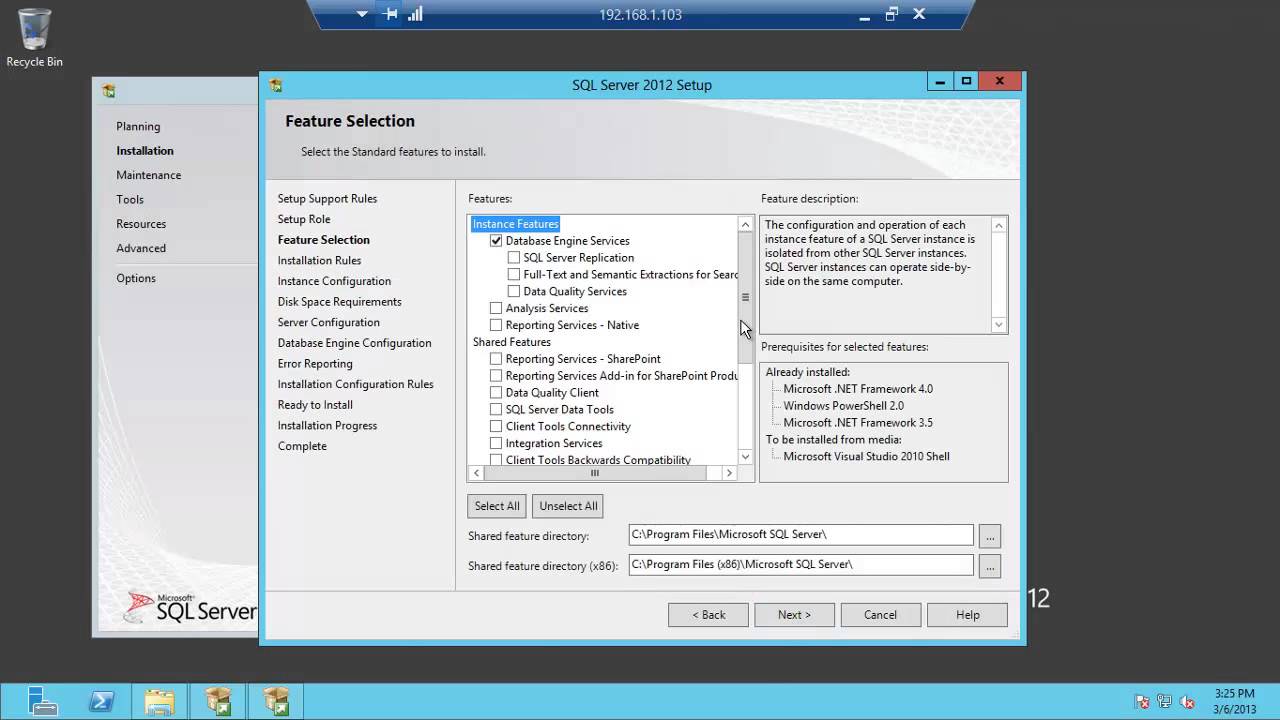
SQL Required Features:
- Database Engine Services
- Full-Text and Semantic Extractions for Search
- Reporting Services Native
- Management Tools – Complete
- Additional selections based on need
- Name pipes (Enabled) after SQL is installed.
PowerShell Scriptto Install all required Roles and Features
PS Script [Add-WindowsFeatureWeb-Windows-Auth,Web-ISAPI-Ext,Web-Metabase,Web-WMI,BITS,RDC,NET-Framework-Features,Web-Asp-Net,Web-Asp-Net45,NET-HTTP-Activation,NET-Non-HTTP-Activ,Web-Static-Content,Web-Default-Doc,Web-Dir-Browsing,Web-Http-Errors,Web-Http-Redirect,Web-App-Dev,Web-Net-Ext,Web-Net-Ext45,Web-ISAPI-Filter,Web-Health,Web-Http-Logging,Web-Log-Libraries,Web-Request-Monitor,Web-HTTP-Tracing,Web-Security,Web-Filtering,Web-Performance,Web-Stat-Compression,Web-Mgmt-Console,Web-Scripting-Tools,Web-Mgmt-Compat-Restart ]- Click Start, click Run, and then enter dsa.msc to open the Active Directory Users and Computers administrative tool.
- Click View, and then click Advanced Features.
- Expand the System container.
- Right-click System Management. On the context menu, click Properties.
- In the System Management Properties dialog box, click the Security tab.
- Click Add to add the site server computer account and grant the account Full Control permissions.
- Click Advanced, select the site server’s computer account, and click Edit.
- In the Apply onto list, select This object and all child objects.
- Click OK.
Hardware:
Windows Server 2016 SQL Server and Reporting Services 2016 Hyper-V 2016 Virtual Machine.MicrosoftRecommendations
- 2 x Quad-Core (Intel Xeon E5504 or comparable)
- 32GB of RAM
- 350GB – 950GB total hard disk space* (OS, ConfigMgr, SiteDB, TempDB)
Step by Step Installation:
- Extract the content from the SC_ConfigMGr_SCEP package.
- Run the HTA to start the Primary Site installation.